Quantum bits, or qubits, are key components in many quantum computers. Unlike classical bits, which can be either 0 or 1, qubits can also exist in a superposition of both states, allowing quantum computers to process information in a way that exceeds classical computers for some problems. Channeling the power of qubits could advance fields like medicine and materials science.
Superconducting qubits are made from materials that lose electrical resistance when cooled to near absolute zero. This allows for extremely fast quantum operations, often completed in billionths of a second.
Qubits are incredibly delicate, like a gyroscope spinning on a smooth surface. If the surface is clean and free from disturbances, the gyroscope spins steadily. However, the slightest imperfection, such as a speck of dust or a vibration, can cause it to wobble and fall.
Similarly, qubits rely on a fragile quantum property called coherence, which allows them to maintain superposition. But heat, noise or material flaws can cause decoherence, destroying this superposition and forcing the qubit to lose information. That’s why superconducting qubits, which are particularly sensitive to decoherence, require ultraclean, cold environments to function properly.
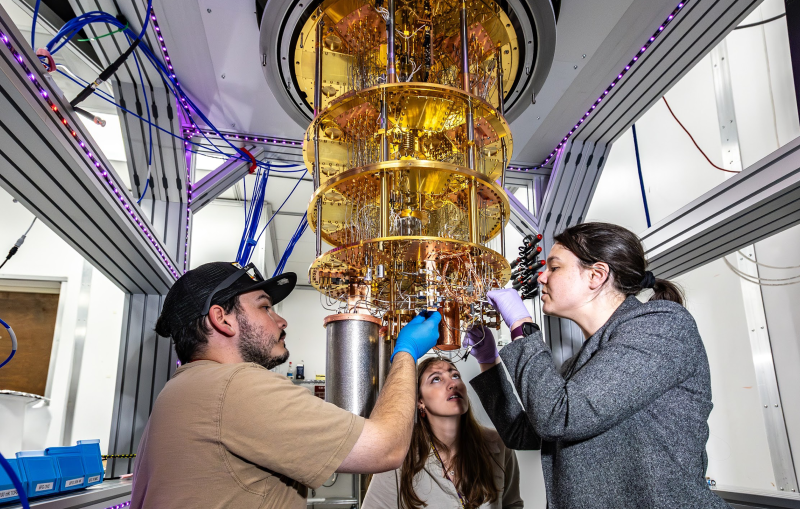
Researchers at the Department of Energy’s SLAC National Accelerator Laboratory are exploring ways to enhance the precision and coherence of superconducting qubits by employing advanced fabrication techniques and state-of-the-art measurement tools.
SLAC staff scientistThe scale of the lab is invaluable as we work to develop practical quantum devices.

“The scale of the lab is invaluable as we work to develop practical quantum devices,” says SLAC staff scientist Shannon Harvey, who studies superconducting qubits. “SLAC combines the expertise of lifelong researchers in diverse fields with advanced tools that let them focus on creating nearly perfect devices. Our collaboration with academic experts from Stanford University in superconducting technologies and quantum information gives us a unique edge in building high-fidelity qubits that will make quantum computing practical.”
For questions or comments, contact the SLAC Office of Communications at communications@slac.stanford.edu.
About SLAC
SLAC National Accelerator Laboratory explores how the universe works at the biggest, smallest and fastest scales and invents powerful tools used by researchers around the globe. As world leaders in ultrafast science and bold explorers of the physics of the universe, we forge new ground in understanding our origins and building a healthier and more sustainable future. Our discovery and innovation help develop new materials and chemical processes and open unprecedented views of the cosmos and life’s most delicate machinery. Building on more than 60 years of visionary research, we help shape the future by advancing areas such as quantum technology, scientific computing and the development of next-generation accelerators.
SLAC is operated by Stanford University for the U.S. Department of Energy’s Office of Science. The Office of Science is the single largest supporter of basic research in the physical sciences in the United States and is working to address some of the most pressing challenges of our time.
Quantum explained

Related stories
Containing multitudes: SLAC scientist collaborates to create scalable qubits


Containing multitudes: SLAC scientist collaborates to create scalable qubits


